
A Reader You Can’t See
My conversation with Beth Barany was about who (or what) is reading author’s works, whether they like it or not.

There’s a point in every conversation I have about AI and writing where the conversation splits. One half wants to talk about ethics: Should this stealing of intellectual property be happening? Who consented? What does this mean for my work? The other half wants to talk about plumbing: how does AI work? Where are the seams? What does a writer DO with this technology?
Beth Barany made room for both halves on How To Write The Future last week, and the episode that came out is the version I keep wishing existed. Don’t panic. Don’t dismiss what’s happening. Instead, we had a practical conversation about books being read by machines instead of people.
You can listen here: How To Write The Future, ep. 206 — AI Content Licensing for Authors. I’d say what I’m about to say is in the episode, but Beth and I covered enough ground that this is a different cut
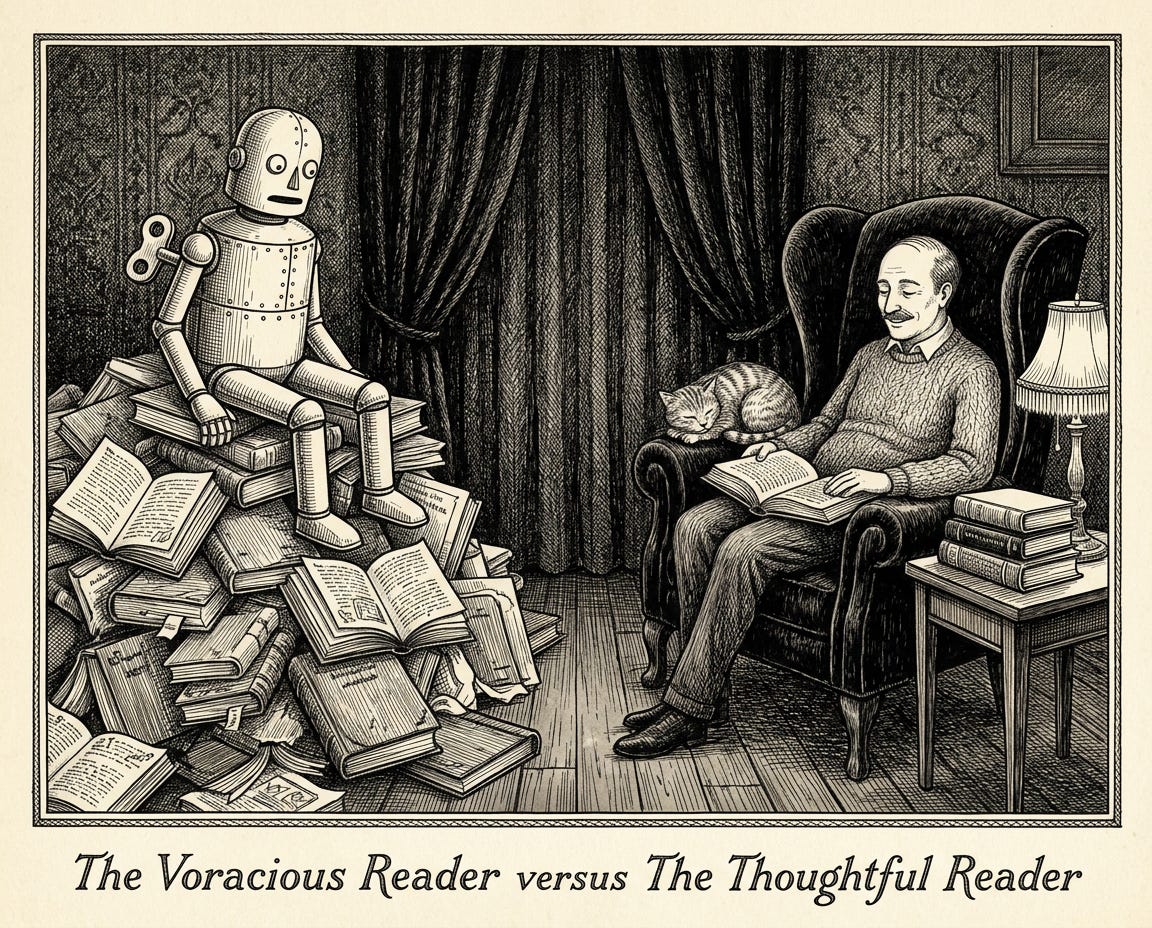
The new reader
The writing industry was built around one assumption: the reader is a person. One person at a time, reading at roughly the speed a human reads. Pricing, formats, rights, distribution were all of it shaped to that one outcome.
The single person reading quietly is now only a small part of how writing gets consumed.
One chatbot can read more in an hour than most of us read in a year. Whatever you write, whether it is books, essays, newsletters, Substacks, posts — there’s a very good chance it has already been ingested into a training set, or that it will be retrieved by a model the next time someone asks the model a question your work would answer.
You can be upset about this or curious about it. Chatbots that read are happening either way.
The infrastructure gap
Here’s the part that surprises people: the legal frameworks already exist for opting out. Article 4 of the EU Copyright in the Digital Single Market Directive says text and data mining is permitted unless you’ve reserved your work in a machine-readable form. The EU AI Act, enforcement deadline August 2, 2026, requires AI providers to detect and honor those reservations.
The catch is in the word “machine-readable.” A blog post on your website saying “please don’t train on my work,” legible in a font designed for human eyes, doesn’t count. A line in your book’s metadata or copyright page that gets stripped when the file is chunked doesn’t count. The “not chatbot readers allowed” opt-out has to be findable, verifiable, timestamped, and content-specific, and it has to travel with the work.
That infrastructure mostly doesn’t exist yet. Which is what Amlet is building. ISCC, an ISO-standard content fingerprint, ISO 24138:2024 — produces a digital fingerprint derived from the work itself. The fingerprint survives reformatting, chunking, even translation. A passage from a German translation of an Italian original can be matched back to the source title.
You can register the fingerprint. Declare your terms, and the bots will understand your intentions.
What this is and isn’t
This isn’t about blocking machines. Most authors I work with don’t want to be invisible to AI. They want to be discoverable, recommended, and cited. Visibility is good. The question is whether you’re visible on your own terms, with an audit trail that proves it.
This also isn’t about waiting for the government to fix this. The EU has done its job. A deadline for complying has been set. What’s missing is the standard that lets a publisher do what the regulation asks, which is to make permissions machine-readable. The market is filling that gap right now. Publishers who declare early are the ones whose declarations will stick when an AI developer says “we honored everything that was declared at the time of training.”
A declaration in 2026 cannot retroactively cover content ingested in 2024, but it is good from today into the future.
Why I keep talking about this
Because the alternative is silence, and silence in machine-readable terms means consent.
If you’re an author, a publisher, an indie writer with a newsletter, a Substacker with a decade of essays — your work is being read by machines, and you can shape how it is used (and prove ownership in the case it is used unlawfully). There’s also a version where the AI just keeps ingesting your work. The infrastructure for the first version of protection exist. It’s worth the few hours it takes to set up.
Beth’s episode is the gentlest way I know to wade into this. She’s a sci-fi/fantasy writer first, and you can feel that in the way she holds the conversation. The technology is in service of the writers, not the other way around.
Go listen: How To Write The Future, ep. 206.
And if you’ve been waiting for someone to tell you what to do about AI and your writing — Amlet’s waitlist is at amlet.ai. I’m one of the people answering questions on the other side of that form.
Cheers,
Julie